
J-Prep and J-Bevel Beveling for Orbital Welding: Geometry, Specs, and Field Production
Orbital welding has become the standard joining method anywhere weld consistency, repeatability, and inspection-ready quality matter most — pharmaceutical and biotech process piping, semiconductor gas delivery systems, food and beverage sanitary lines, and increasingly, high-pressure power generation and aerospace tubing. The automated weld head that makes orbital welding so consistent has one critical dependency: it can only be as good as the joint geometry it’s given.
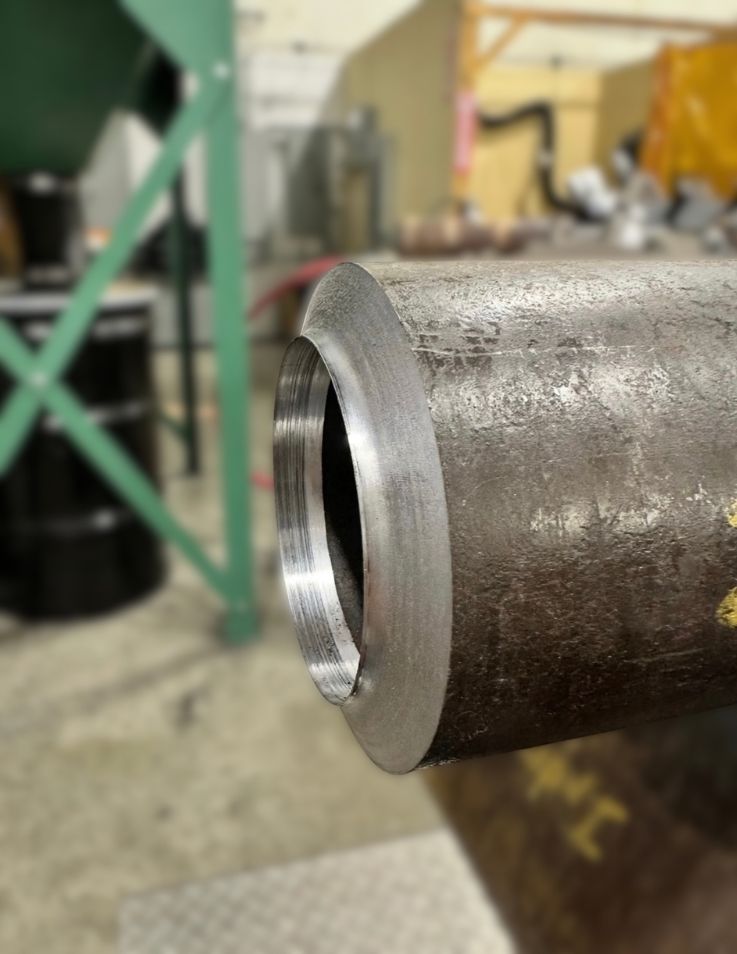
That’s where the J-bevel — also called a J-prep — comes in. Unlike a standard V-groove bevel, the J-bevel uses a curved radius profile specifically engineered for the narrow, controlled arc of orbital GTAW (gas tungsten arc welding). A J-prep produced by hand grinding cannot meet the dimensional tolerance an orbital weld head requires. This is a machine-only operation.
This guide explains the J-bevel geometry, why orbital welding requires it, the industry specifications that govern it, and how to produce a code-quality J-prep in the field using a MILLHOG® beveling machine.
What Is a J-Bevel? Understanding the Geometry
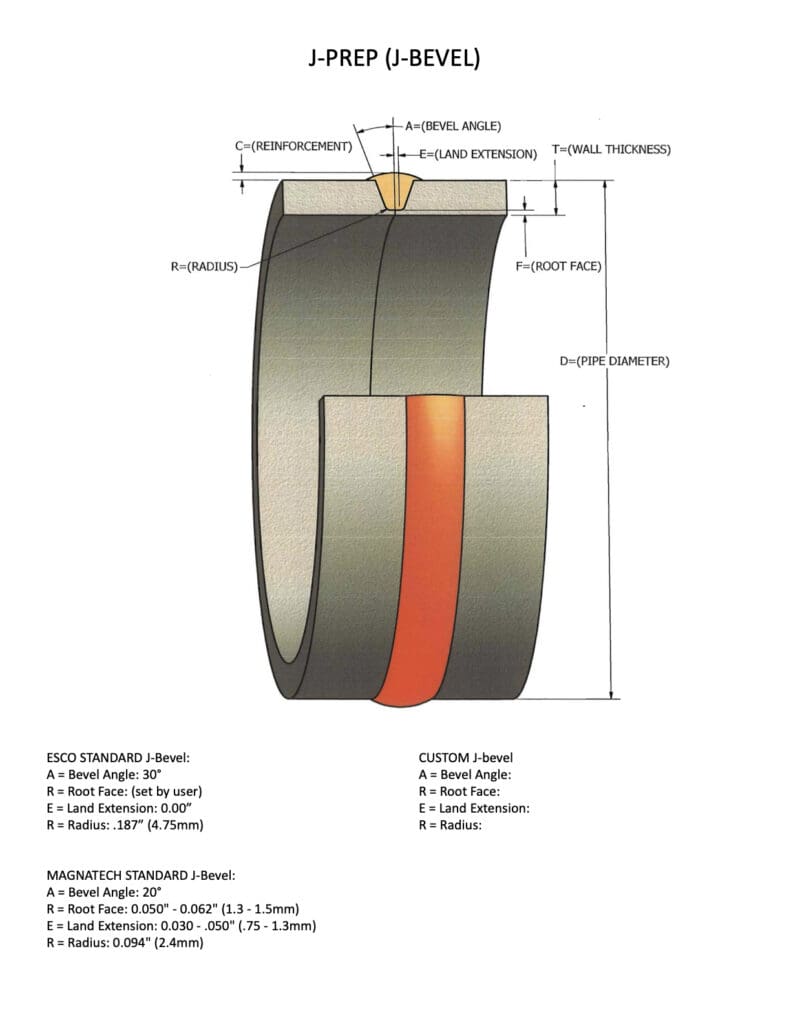
A standard V-groove bevel — the 37.5° bevel used in most conventional arc welding — creates a wide-angle groove that a manual welder can fill in multiple passes, adjusting the puddle by eye as they work down the groove. A J-bevel is fundamentally different geometry: instead of a straight angled face, the bevel profile curves into a radius as it approaches the root, creating a groove that resembles the letter J in cross-section.
The radius profile reduces the cross-sectional area that must be filled with weld metal compared to a V-groove of the same depth. This matters enormously for orbital welding, where the weld head delivers a precisely controlled, narrow arc and a fixed filler wire feed (or no filler at all, in autogenous orbital welds). A J-bevel’s narrower groove and consistent root geometry allow the orbital head to achieve full penetration with minimal weld metal and minimal heat input — both of which are critical for thin-wall tubing and high-purity process applications.
Standard J-Bevel Dimensions
The most common J-bevel specification used across orbital welding applications calls for a 22° bevel angle with a 3/16″ (4.7mm) radius at the root. This is the standard geometry produced by Esco Tool’s MJB series cutter blades, and it aligns with the specifications most frequently called out in orbital welding procedure qualifications across pharmaceutical, semiconductor, and process piping applications.
The exact J-bevel angle, radius, and root face dimension for a given joint are specified in the project’s Welding Procedure Specification (WPS), which is qualified against the applicable code — ASME BPE (Bioprocessing Equipment) for pharma and biotech, ASME B31.3 for process piping, or SEMI standards for semiconductor gas delivery systems. The 22°/3/16″ configuration is a common default, but custom radius and angle combinations are produced regularly for specific procedure requirements.
Key spec: Esco Tool’s standard J-bevel cutter blade (MJB series) produces a 22° bevel with a 3/16″ (4.7mm) standard radius, available in 1/2″, 3/4″, 1″, and 1-1/4″ widths. Custom radius and angle combinations are available — consult the factory with your WPS requirements.
Why Orbital Welding Requires a Machined J-Prep
Dimensional Consistency Around the Full Circumference
An orbital weld head travels 360° around the tube or pipe joint in a single automated pass, maintaining constant arc length, travel speed, and current profile programmed for the joint geometry it expects to see. If the J-bevel geometry varies around the circumference — wider in one spot, narrower in another, inconsistent root face — the weld head’s pre-programmed parameters no longer match the actual joint at every point. The result is inconsistent penetration: areas of incomplete fusion where the groove is wider than expected, and potential burn-through or excess penetration where it’s narrower.
A ground J-prep — produced freehand with a die grinder and a radius burr — simply cannot hold the dimensional consistency that orbital welding demands. Operator hand position, pressure, and burr wear all introduce variation around the circumference. A machined J-prep, produced by a rotating cutterhead with a fixed-geometry formed blade, reproduces the identical profile at every point around the joint.
Surface Finish and Root Condition
Orbital welding — particularly autogenous welding without filler wire, common in high-purity tubing applications — relies on a clean, smooth root face to achieve consistent fusion. A ground surface carries grinding marks, embedded abrasive particles, and surface contamination that can introduce porosity or inclusions in the weld root. A machined bevel produces a clean, continuous-chip surface with no embedded contamination — critical for the cleanliness standards in pharmaceutical and semiconductor applications, where the weld root surface finish is often specified by Ra value in the WPS.
Repeatability Across Hundreds of Joints
Orbital welding’s primary value proposition is repeatability — the same weld quality on joint 1 and joint 500 of a piping system. That repeatability is only as good as the weakest link in the process, and weld prep is frequently that weak link when grinding is used. A beveling machine with a fixed-geometry cutter blade produces the same J-bevel profile on every joint, removing weld prep variability from the process entirely.
Orbital welding procedure qualification records (PQRs) typically specify the exact bevel geometry used to qualify the weld procedure. Field welds must replicate that exact geometry — not an approximation. This is a primary reason inspectors and quality engineers increasingly specify machine-produced J-preps rather than allowing ground preparation on orbital welded joints.
Producing a J-Bevel in the Field: Tool Selection
J-bevel preparation in field conditions — as opposed to a controlled shop environment — requires a portable I.D. clamping beveling machine configured with a J-bevel cutter blade. Esco Tool’s MILLHOG® line covers J-bevel production from small-diameter tubing through large pipe.
Prepzilla MILLHOG® — The Primary Tool for J-Prep Work
The Prepzilla MILLHOG® (1.575″ I.D. to 8.625″ O.D.) is purpose-built for the precision and surface finish demands of orbital welding applications. Its low-rpm, high-torque gear drive produces a chatter-free cut at the cutting speeds appropriate for thin-wall, high-alloy tubing common in orbital welding applications.
Rounding Pads: The Prepzilla’s Rounding Pads are specifically designed to maintain the roundness of thin-wall pipe and tube during beveling, eliminating distortion and vibration. Thin-wall tubing — common in pharmaceutical and semiconductor applications — deflects easily under clamping or cutting force. An out-of-round tube end directly compromises orbital weld head tracking, since the head follows the tube profile around its travel path. The Rounding Pads hold the tube true throughout the cutting operation.
Third Cutter Blade Tool Post: The optional P-20-375 tool post allows the Prepzilla to bevel, face, and bore simultaneously — useful when the J-prep geometry requires a combination of operations to achieve the full WPS-specified profile in a single setup.
Motor options: Pneumatic, electric, and hydraulic motors are available and easily interchanged. The electric motor’s variable speed range (9–31 rpm) provides the fine speed control valuable for dialing in the correct cutting speed on stainless and high-alloy tubing common in orbital welding work.
Commander and Dictator MILLHOG® — For Larger J-Prep Diameters
For larger-diameter J-bevel applications — power generation steam piping, larger process lines — the Commander MILLHOG® (3.75″ I.D. to 14″ O.D.) and Dictator MILLHOG® (4.5″ I.D. to 18″ O.D.) accept the same M Series cutter blade family, including the MJB J-bevel blades, in the appropriate width for the application. Both tools offer the gear box torque multiplier option, important for J-prep work on high-alloy pipe where work hardening is a factor.
Ground MILLHOG® — For Small-Diameter Tube J-Prep
J-prep work is also a listed application for the Ground MILLHOG® (0.5″ I.D. to 2.25″ O.D.) — relevant when orbital welding is performed on small-diameter boiler or instrumentation tubing in power generation applications. The same J-bevel cutter blade geometry applies, scaled to the appropriate blade width for the smaller tube range.
J-Bevel Cutter Blade Specifications
| Blade | Width | Bevel Angle | Radius | Compatible Tools |
|---|---|---|---|---|
| MJB-1 | 1/2″ (12.7mm) | 22° (standard) | 3/16″ (4.7mm) | Prepzilla, Commander, Dictator, Wart, Mini |
| MJB-2 | 3/4″ (19.1mm) | 22° (standard) | 3/16″ (4.7mm) | Prepzilla, Commander, Dictator, Wart, Mini |
| MJB-3 | 1″ (25.4mm) | 22° (standard) | 3/16″ (4.7mm) | Prepzilla, Commander, Dictator |
| MJB-4 | 1-1/4″ (31.8mm) | 22° (standard) | 3/16″ (4.7mm) | Prepzilla, Commander, Dictator |
| Custom MJB | Per WPS | Per WPS | Per WPS | Consult factory |
All MJB blades are TiN-coated as standard, providing the extended blade life and reduced cutting heat that high-alloy and stainless tubing — the most common materials in orbital welding applications — require. For non-standard angle or radius requirements specified in a particular WPS, Esco Tool produces custom J-bevel cutter blades to match.
J-Bevel Production Workflow
Step 1 — Confirm WPS Geometry Requirements
Before any cutting begins, confirm the exact J-bevel angle, radius, and root face dimension specified in the project WPS. If the standard 22°/3/16″ geometry is not specified, a custom blade order must be placed in advance of the field work — custom blade lead time should be factored into project scheduling.
Step 2 — Tool Setup and Clamping
The beveling tool is mounted to the tube or pipe I.D. and clamped. For thin-wall tubing, Rounding Pads (Prepzilla) should be installed to maintain roundness throughout the cut. Tool alignment is confirmed before cutting begins — out-of-square clamping produces an inconsistent bevel even with a correctly profiled cutter blade.
Step 3 — J-Bevel Cutting
The J-bevel cutter blade is installed in the tool post and the cut is made at the rpm appropriate for the tube material. For stainless and high-alloy tubing, lower rpm with higher torque (electric motor variable speed, or gear box option on larger tools) produces the cleanest cut and longest blade life. The cut should produce a continuous, clean chip — the same chip-quality indicator that applies to standard bevel work.
Step 4 — Surface and Dimension Verification
After cutting, the J-bevel profile should be verified against the WPS specification — typically using a radius gauge or bevel profile template specific to the joint geometry. Surface finish (Ra) verification may be required for high-purity applications. Any deviation from spec requires re-cutting before the joint proceeds to orbital welding.
Step 5 — Tube End Cleaning (High-Purity Applications)
For pharmaceutical, biotech, and semiconductor applications, the freshly cut J-bevel surface often requires solvent cleaning or passivation per the project’s cleanliness specification before welding. This step is procedure-specific and should be confirmed against the project’s quality requirements.
J-Bevel vs. Standard V-Groove: A Side-by-Side Comparison
| Factor | Standard V-Groove (37.5°) | J-Bevel (22° / radius) |
|---|---|---|
| Typical application | Manual/semi-auto arc welding, general construction | Orbital GTAW, high-purity and precision tubing |
| Groove cross-section | Wider — more weld metal required | Narrower — less weld metal, less heat input |
| Production method | Machine or careful grinding (less critical applications) | Machine only — dimensional tolerance too tight for grinding |
| Weld passes | Often multiple passes | Typically single pass (autogenous or single filler pass) |
| Typical industries | Power gen, structural, general pipe fab | Pharma/biotech, semiconductor, food & bev, precision power gen |
| Inspection standard | Visual + RT/UT per code | Visual + boroscope + RT; often 100% inspection |
Frequently Asked Questions
Can a J-prep be produced by grinding if the budget doesn’t allow for a beveling machine?
Not for orbital welding applications that require code or procedure compliance. The dimensional consistency that orbital weld heads require around the full joint circumference cannot be reliably achieved by hand grinding. Most orbital welding procedure qualifications explicitly require machine-produced bevels. Grinding may be acceptable for repair or touch-up of a small localized area, but not as the primary J-prep method.
What is the difference between a J-prep and a J-bevel?
The terms are used interchangeably in the industry to describe the same curved-radius bevel geometry used primarily for orbital welding. “J-prep” more commonly refers to the overall weld preparation process; “J-bevel” more commonly refers to the specific cutter blade geometry. Both describe the same end result.
Does every orbital weld require a J-bevel?
No. Some orbital welding procedures, particularly on heavier wall tubing or pipe, use a standard V-groove or modified V-groove geometry. The J-bevel is most common on thinner-wall, high-purity tubing applications where minimizing weld metal volume and heat input is a priority. The WPS for the specific application determines the required bevel geometry.
What pipe and tube sizes can Esco Tool produce J-bevels on?
The MILLHOG® line covers J-bevel production from 0.5″ I.D. tubing (Ground MILLHOG®) through 18″ O.D. pipe (Dictator MILLHOG®), using the appropriate MJB blade width and tool selection for the application size.
How long does J-bevel production take compared to a standard bevel?
J-bevel cutting time is comparable to standard bevel cutting time on the same beveling machine and pipe/tube size — the radius geometry of the cutter blade does not significantly change cutting speed. Total cycle time depends primarily on material, wall thickness, and tool/motor selection rather than bevel geometry.
Need Help Specifying Your J-Bevel Application?
Esco Tool’s application engineers work with orbital welding procedure specifications across pharmaceutical, semiconductor, food and beverage, and precision power generation applications. We can match the correct tool, blade geometry, and motor configuration to your WPS requirements — including custom J-bevel blade angles and radii. Explore our J-prep beveling machines for orbital welding, or contact a specialist to discuss your application.
MILLHOG® beveling tools are available for sale or rent with nationwide delivery. Call (800) 343-6926 (US & Canada) or 508-429-4441 (worldwide).